
Subatomic particles. But we'll worry about these later.
(source: http://goo.gl/5BYuw)
These tiny, barely visible (with the proper equipment, mind you) foundations of matter generate the chemistry we know and love today. As such, it is no surprise that most general chemistry students start the long, grand process of chemical education by learning about this fundamental building block. Today, I'd like to explore the concept of atoms in a different way. I'll introduce the first concepts of atoms and end with where chemists (and physicists!) heading in our atomic studies.
But where did this concept of atoms come from? Well, according to wikipedia, atoms were the brain-child of early philosophers.

Like this guy. At least he wears clothes to do science!
(source: http://goo.gl/Ctu66)
Essentially, atoms were based on a simple reduction principle; if one was to break something (anything, according to that time frame) down into smaller and smaller parts, eventually you would not be able to break this object down any further and still have that object. Philosophers called the smaller portion of something atomos, which means indivisible, or cannot be cut. From there, they gave these atoms characteristics based on what they observed in the real world. Air atoms were light and fluffy since they were self-suspending, earth atoms were solid since one could stand on them, salt atoms were pointed due to their taste Most notably, however, was the idea that atoms were essentially uniform and incompressible.
Note that these philosophers had no sophisticated equipment or funding from the NSF, they just think about these things. As such, you could hardly call their findings empirical. Most of us would just laugh at how absurd it sounds in today's world. Air atoms? But we can't just pass this off and move onto the next topic in C&E News (however stimulating it might be). These ideas were earth-shattering for their time, where philosophers represented the most forward thinking humans on any subject, from ethics to science. I would argue that almost all science is now the birthchild of these early philosophers. After all, most of us don't keep a mass spec inside our bedrooms (I hope), but we all have our brains.

My bedroom closet in the background.
(source; http://goo.gl/zuFeE)
Of course, through the thousands of years since that time, mankind has established many fundamental principles of science that explain broad and often abstract concepts. Many of these principles, however, still date back to the first theories of atoms. After all, quantum mechanics was based on the principles of electrons, which came about largely due to the first atomic models.
What is the take home message here? Well, I'm certainly not trying to show that atoms exist, there are plenty of people way more intelligent (and probably better looking) than I am that have already shown this. What am I attempting to point out is science can be started from a single thought. It is much better to pursue wrong ideas than to simply have no ideas at all. Besides, if we had stopped at the first sign of a wrong idea rather than attempting to modify that idea into a right one, we never would have had the pleasure of seeing the ultimate atomic idea in action; the Large Hadron Collider (LHC).
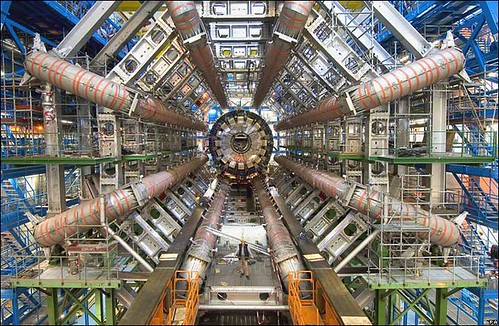
Cue the Star Wars Theme.
(source: http://goo.gl/oOy86)
