Thursday, July 7, 2011

Waxing Philosophically on Chemistry

So, I'm relatively new to the blogging scene in general, let alone anything involving chemistry.  Recently,  Scientific American (Twitter: @sciam) released their lineup of excellent and engaging bloggers, of which three are chemists.  Glen Ernst (@geernst),  who I've followed on Twitter, linked an excellent response to the relatively small number of chemists represented here.  I'm going to do a little bit of disclaiming here, so in my usual fashion, I'll insert a picture:


Seriously, how cute is this?
(source: http://goo.gl/GIxHt)

I'm by no means an excellent blogger, nor would I ever hope to grace the e-paper of a blog like Scientific American, but I feel the goal of my blog is in line with some of the critiques given by the author of the blog in his posting.  I want to make Chemistry accessible to everyone, all over the world.  Granted, given the relatively new nature of my blog, I have to start somewhere, and atoms / electrons seem like a great place to start.  But is this not chemistry as well as physics, even biology?  Is there really a hard line that states "Beyond (insert definite science term) point, we are now speaking about physics."?  What defines us as chemists, or philosophers?  I feel these definitions are a little loose to some, but very strict to others.  There are new generations of chemists (myself included) that could be seen as physicists, or biologists, or nanomaterial specialists, or anything similar.

The point is, where do we begin?  Well, as I said before, the beginning always seems like a nice place.  You can't get to talking about a Hamiltonian and wave-functions without talking about wave-particle duality, which involves electrons.  Then you branch into bonding, molecules, experimentation, and everything explodes from there.  There are literally dozens of blogs that describe intimate details of chemical structure, with various nuances that even the most trained chemist might miss.  These are very important in the scientific community as well.  The exchange of ideas that occurs here is phenomenal, and should be promoted at every opportunity.

 Boom, Einstein!  Betcha didn't see that one coming.
(Source: http://goo.gl/Ui6NE)

I'm aiming at  a light-hearted approach to science  with a literary style that is easy to understand, is accessible to a broad audience, and contains a chemistry twist.  Some might call my writing "juvenile" and comical, but if you end up talking about what's contained in my blog, then I have done my job.  I have gotten you interested, in one form or another, in how science works.  If I can invade your mind in that small way, maybe I can stick a piece of knowledge in there that will stay for a lifetime, and make you want more.

Thursday, June 30, 2011

Electrons and You

For full disclosure: My wife and I are both scientists, though I consider myself more of a "thinker" than a scientist in general.  We rarely speak about chemistry in our normal conversations, but our favorite joke is usually "Are you positive?"  "Yes."  "Did you lose an electron?"

 Oh yea, I went there.
(Source: http://goo.gl/43kk)

So what exactly are electrons?  Well, that's a pretty complicated question, and I will try to give you some basic answers with a lot of interesting links.  When atoms were first being studied, it was difficult to look solely at the individual parts that make up an atom (the protons, neutrons, and electrons).  Atoms were presented using a variety of different models.  One that is still in use today is the Bohr Model of the atom.  My favorite is the Pudding Model, however.

  Atoms are delicious and nutritious!
(Source: http://goo.gl/Ecewf)

 These models attempt to explain the relative positions of the protons, neutrons, and electrons, relative to the theories at the time.  Electrons (usually the plum bits in the pudding), were almost always relegated to the outside of the nucleus.  Ernest Rutherford performed a famous experiment that said rather than pudding, atoms are mostly empty space, with electrons account for a very small portion of the actual atomic density.  But electrons are where the magic happens.

These flying little particle/waves (don't worry if that sounds like a contradiction, I'll hit on this later) can transfer between atoms, giving and creating positive / negative charge, can be shared, or can become "free floating" inside of materials (atomic scaffolding like metals, etc).  Simply by moving back and forth, electrons change the properties of atoms drastically and producing chemical reactions.  The periodic table is also based on an atom's electronic properties, and new, exciting materials coming out of modern science exploit some of the basic properties of electrons.

I've listed a few reasons electrons are quite possibly the most important aspect of chemistry.  However, continuing research is still trying to make sense of all of the science behind these little yellow wonders (aside: am I the only one that thinks of electrons as yellow?)

 Like this yellow.
(Source: http://goo.gl/1JNfi) 

Thanks to everyone reading my blog, and the encouragement that I've received to continue.  I hope this new post satisfies, and look for more to come!

Wednesday, April 13, 2011

Chemistry: Is It Under My Bed?

After recently having the wonderful opportunity to teach an introductory chemistry course to a class of non-majors, I found my biggest challenge was to find a way to connect with my students.  Being not terribly old myself, I thought that I could stand in front of them, wave my hands excitedly, make a complete fool out of myself, and everyone would take me seriously.  After a few lectures of this, I came to the conclusion it was not working.  Surprise, surprise.

 Very surprised.
(source: http://goo.gl/yy7Qh)

After stewing in thought for a few days, I realizes something that I had never truly expounded upon before; chemistry is literally, everywhere.  From the keys on the keyboard I'm using to write this blog post to the coffee you drink in the morning to the slightly more fun liquid refreshment others consume in alarming quantities on the weekends, Chemistry has always been a large part of life!  So I began with some simple examples.  Most students in my class could correctly identify NaCl on the board.  The conversation went something like this:

Me: "Yes, NaCl is a salt."  
Students: "No, NaCl is salt."
Me: "Ah, but there are other things besides NaCl that are known as salts.  For instance..."
Students:  "Burn the Heretic!"
The previous scene may be a slight exaggeration.
(source: http://goo.gl/YNcOM)

We then went onto discuss salts and salt solutions, solubility rules and the like.  I explained what happened, on the molecular level, when something dissolves.  The next day, a student asked me if it was weird that he watched the sugar in his coffee dissolve before he drank it.  With a goofy grin, I told him, "Only if you weren't thinking about solubility."

The semester went on, and eventually we started discussing food chemistry.  Things like how enzymes work in the body, how food is broken down, stored, and eventually used as a source of energy.  In my admittedly short career as a chemist, one of my most satisfied moments came when a student told me;

"I'll probably never look at food the same way again."

And that, my friends, is the entire point of chemistry!  Everything in this world should constantly be changing your perception, challenging you to understand why, what is happening, how can we make it better, more effective, or change this process in some way?  From the farthest reaches of space to the dust mites under your bed, chemistry is everywhere.  Changing your perceptions to understand the science only improves your notions of the world.  And who knows, you might learn a thing or too as well.

{Note:  The author has repeatedly stared at innocuous solutions while adding various salts, hoping something sinister will develop.}

Wednesday, March 30, 2011

Atoms: What in the World?

If the title of this blog post has ever crossed your mind, then the first thing I'd say to you is; You'd be right!  Atoms are the world. Granted, there are particles that are being discovered as I write this blog that are smaller than atoms, but you get the point.

Subatomic particles.  But we'll worry about these later.
(source: http://goo.gl/5BYuw)


These tiny, barely visible (with the proper equipment, mind you) foundations of matter generate the chemistry we know and love today.  As such, it is no surprise that most general chemistry students start the long, grand process of chemical education by learning about this fundamental building block.  Today, I'd like to explore the concept of atoms in a different way.  I'll introduce the first concepts of atoms and end with where chemists (and physicists!) heading in our atomic studies.

But where did this concept of atoms come from?  Well, according to wikipedia, atoms were the brain-child of early philosophers.

Like this guy.  At least he wears clothes to do science!
(source: http://goo.gl/Ctu66)

Essentially, atoms were based on a simple reduction principle; if one was to break something (anything, according to that time frame) down into smaller and smaller parts, eventually you would not be able to break this object down any further and still have that object.  Philosophers called the smaller portion of something atomos, which means indivisible, or cannot be cut.  From there, they gave these atoms characteristics based on what they observed in the real world.  Air atoms were light and fluffy since they were self-suspending, earth atoms were solid since one could stand on them, salt atoms were pointed due to their taste  Most notably, however, was the idea that atoms were essentially uniform and incompressible.

Note that these philosophers had no sophisticated equipment or funding from the NSF, they just think about these things.  As such, you could hardly call their findings empirical.  Most of us would just laugh at how absurd it sounds in today's world.  Air atoms?  But we can't just pass this off and move onto the next topic in C&E News (however stimulating it might be).  These ideas were earth-shattering for their time, where philosophers represented the most forward thinking humans on any subject, from ethics to science.  I would argue that almost all science is now the birthchild of these early philosophers.  After all, most of us don't keep a mass spec inside our bedrooms (I hope), but we all have our brains.

My bedroom closet in the background.
(source; http://goo.gl/zuFeE)

Of course, through the thousands of years since that time, mankind has established many fundamental principles of science that explain broad and often abstract concepts.  Many of these principles, however, still date back to the first theories of atoms.  After all, quantum mechanics was based on the principles of electrons, which came about largely due to the first atomic models.  

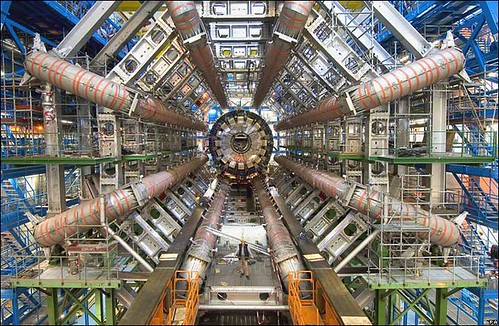
What is the take home message here?   Well, I'm certainly not trying to show that atoms exist, there are plenty of people way more intelligent (and probably better looking) than I am that have already shown this.  What am I attempting to point out is science can be started from a single thought.  It is much better to pursue wrong ideas than to simply have no ideas at all.  Besides, if we had stopped at the first sign of a wrong idea rather than attempting to modify that idea into a right one, we never would have had the pleasure of seeing the ultimate atomic idea in action; the Large Hadron Collider (LHC).

Cue the Star Wars Theme.
(source: http://goo.gl/oOy86)

Wednesday, March 23, 2011

Educate the World in Chemistry!

Chemistry is such an interesting subject, more in that it is related to everything.  From the air we breathe to the water we drink, to the clothes we put on, and even what we watch on television!  Chemistry is everywhere, and I challenge people to think about a place in their lives where chemistry is NOT relevant!

This is my first post here on Chemistry and Education (aka ChemEdtheWorld!), but I hope to put more effort into this blog.  I will point out interesting articles for viewers to read, relate real-world stories to science in a way that is understandable, and generally have fun with my favorite scientific subject.  Check out this blog from time to time if you're ever interested in what is happening in the world!